Saturday, April 6, 2019

Dallas Morning News Printing Plant Tour

We continued on Friday with our staycation activities sponsored by the Dallas Morning News.  The DMN is offering a number of activities as outreach for their subscribers.  This was a tour of their huge printing plant on Plano Parkway in Plano.  It was a really great tour, but I did a terrible job with pictures so this blog does not do the tour justice.


The Dallas Morning News was founded in 1885 and still publishes a daily morning paper.  However the number of papers printed is only about 90,000 per day, down from a high of over 600,000 several decades ago.  I don't know how many online subscribers they have.  Their Wikipedia page says they have almost 272,00 subscribers, so the differences might be online subscribers.  In any case, this tour was about the print part of the business.

What I did not know was that the Plano printing plant also prints regional editions of the New York Times, the Wall Street Journal, USA Today, the Fort Worth Star-Telegram and the Denton Record-Chronicle. Until last week, they also printed about 25 smaller commercial customers and weekly newspapers including the Dallas Observer and Fort Worth Weekly, some local college newspapers and suburban papers.   Those were dropped effective at the end of March as a cost-cutting move.  For that reason nothing was operating when we were there Friday morning...probably a good thing for our ears, but I would have loved to see the presses in operation.

There are seven printing presses at this plant and they are HUGE.  They are at least three stories high each, and I suspect each "story" is more than normal height.  There is one press for each of the newspapers because they use different width rolls of paper.  The "extra" press functions as a backup for any potential crisis. 

A portion of each press handles each section of the paper, i.e. the sections are printing simultaneously.  The pages of each section are cut and folded by the machine, but the sections are put together by the carriers at one of the several (5?) distribution centers. The presses can do some color pages, but they do not do the colored inserts here.

One of the rolls for the New York Times (note NYT in red lettering on side).  Another roll is mounted in the ready position on the press in the back but not actually feeding through the press.  When the active roll is nearly finished, this roll will rotate into position and the blue tape on that roll will engage with the paper on the active roll, allowing the paper to begin feeding into the press.
 
These are rolls ready to move into position on the press.  The track in the foreground is for the little dollies that move them around.  The different width rolls are slightly different weights, but the tag on the NYT roll said 1678 pounds.

The paper rolls are brought in by rail car.  They keep about a month's supply of paper on site. I was impressed by how high they were stacked (5 or 6 high) given that they each weigh nearly 1700 pounds.

Some of the rolls stacked in the warehouse.
I was a little confused about the timing issues, but it was roughly like this.  The printing plant receives the fully laid out pages (from whichever newspaper) as pdf files each evening.  Cutoff times vary with each newspaper, but the cutoff time for DMN (which has the latest cutoff) was about 10:30 pm I think.  That could go later when something newsworthy is happening late, such as a late Cowboys game. 

The pdf files are used to "burn" a flexible aluminum plate for each page of the paper (or 3 additional  plates, one each for blue/red/yellow, if it is a color page).  The aluminum plates are the same size as the page and fit around a roller on the press.  They actually make two plates for each page (or eight total for each color page), since two copes of the same page are printed simultaneously. 

Most of the process to create the plates is computerized, but each plate still goes through a chemical "fixing" process.  Each aluminum plate is used only once and is then sold for scrap.

The press run (at least for the News) usually starts sometime before midnight.  They currently run only one press for the News (used to be 2).  Once up to speed, the press can produce 45,000 - 50,000 papers per hour, although there is typically a loss of 5% or so at the beginning as they get everything aligned correctly.

Once printed, the papers are immediately loaded onto trucks to take to the distribution centers.  The last of the papers produced goes to the distribution center in the basement of the printing plant.  The goal is for the papers to be to the centers by 1:30 am.  It takes the carriers several hours to put the sections together, bag the papers, and load their cars.  The carriers then leave, with the goal of the papers being on front lawns by 5:30.

It was truly fascinating, but I am glad we saw it when we did.  I worry print newspapers may not be around much longer.

Monday, April 1, 2019

A Day at the Races

We spent most of Saturday at the races.  No, it was not Ascot or even Churchill Downs, but Texas Motor Speedway for a NASCAR race and in a luxury suite no less!!  We saw some qualifying runs, practice runs, and the main event of the day, the My Bariatric Solutions 300 NASCAR race.  Admittedly this was in the xfinity series of NASCAR, which is essentially the "minor leagues" of NASCAR.  The regular NASCAR race was Sunday afternoon and the truck race was Friday night.  However, the xfinity series was just fine with us because we are not NASCAR fans anyway.  It was just fun being there and taking in everything.


What??!!  You went to a NASCAR race??!! As I related our plans to other folks before our adventure, people tended to fall into two camps, either (1) Wow, that is awesome, or (2) Umm, I won't insult you by saying it out loud but you could not pay me to do that.  Given that we are not even NASCAR fans, how did we end up there?  Well, of course there is a back story, if only a minor one.

We are longtime Dallas Morning News subscribers.  DMN contacted the Frog, whose name is on the subscription, and gave him the opportunity to enter a drawing open to subscribers with a variety of different prizes.  Lo and behold we won two tickets in the Dallas Morning News' luxury suite to the My Bariatric Solutions 300 NASCAR race on Saturday, March 30. Also included was VIP parking, continental breakfast (or at least sweet rolls) and lunch.  It was wonderful.  We really had a great time. 

Small crowd.  Texas Motor Speedway is a 1500 acre speedway located in very far north Fort Worth.  In fact, it is so far north it is in Denton County.  Based on an estimated capacity of over 181,000 fans, it is the second largest sporting venue (based on capacity) in the U.S.  However, due to the horrible weather, the crowd on Saturday was very small.


Front straightaway with pit row to the right as seen from our seats.  Although this was before the race, it was obvious the crowd was going to be tiny.


A blue norther had blown in that morning.  It was COLD and overcast made even worse by an incredibly strong north wind.  I don't know about sustained winds, which were significant, but the weather person on TV later said the gusts were to 40 mph.  Under normal conditions it would have been fun to explore the many vendor booths set up outside, but it was just too cold and windy. Thank goodness for being in a suite!

Great views of everything.  According to NASCAR it is a 1.5 mile quad-oval track, although IndyCar apparently thinks it is 1.44 miles...whatever.


We were on the first of two levels of suites very near exit 6 on the map above.  They were great seats near the end of the front straightaway just before turn 1.  We could easily see the entire track and the large video screen, "Big Hoss", on the other side of the track.  We were amazed at how much easier it was to follow the race compared to watching on TV.  There was also tv coverage in the suite, although we could not see the monitors very well since we chose seats all the way in the front.


Some of the cars during practice for Sunday's race.  Big Hoss is on the right.  Turns 3 and 4 are in the distance.  Pit row is in the center, with the main straightaway on the left.


Turn 1 and turn 2 (south end) during practice.

It was amazing how fast the cars moved, especially during the qualifying rounds.  According to the display on Big Hoss, the top qualifiers were all going in excess of 190 mph.


I was impressed with the speeds especially since these were xfinity Series cars, which according to someone sitting behind us have smaller engines and 200 hp less than the regular NASCAR cars.

One of the other major differences to seeing the race on tv was the color of the cars.  It was obvious how useful that was to identifying them from a distance.


For that matter, there was color everywhere despite the drab, gray day.

All the pit crews lined up for the singing of the national anthem.

Some of the different track support personnel (ambulance drivers, wrecker drivers, etc.)

 
It was also interesting to see all of the many different support vehicles, some of which I still don't understand.  One vehicle looked like it had a large magnet on the back, but I somehow missed getting a decent pic.  All of these services and more had to be in the right place at the right time and people fed since it was an all day event.  The logistics in putting on this type of event is staggering.


Handing out box lunches to the support personnel in the downtime between practice runs and start of the race.

If the weather would have been better, people watching would have been interesting.  At the very least, we saw the ferris wheel and some unusual vendor trucks.


The ferris wheel looks small from here, but is actually quite large.


Of course the main attraction was the race itself.  Car number 20, driven by Christopher Bell had the pole position and led most of the race.  Shown below is one of his pit stops.  Note in particular how fast each of the five lug nuts on each wheel is loosened and tightened, one "jab" each.


There were the smattering of various accidents.  For many it was a matter of pulling loose parts off the car and sending the driver on his way.


Pulling parts off the car and out of the tire well before going back on the track.


Checking things out after an altercation with another car.  Note the tire marks on the side of the car.


Of course some wrecks required towing the cars away, even as the other cars kept circling under yellow.


Support vehicles around the damaged 07 car


Car #74 passes on the high side as the wrecker attaches to the wrecked car.

The restart after a yellow was always exciting, with much maneuvering for position.


The final victor was Kyle Busch, who was actually a "major league" driver who was running in the xfinity series.  He had also won the truck race the night before.

Number 18 doing circles after winning the race.

However, I have to point out that #74 was the Frog's favorite car.  He had many more pit stops than most of the rest of the field and he was noticeably slower which meant he kept getting lapped, but he was still running at the end!


Our favorite car because he was at the back and kept getting lapped.


As I hope you can tell, we had fun and learned quite a bit about NASCAR racing that was largely unknown to us before.  Thank you Dallas Morning News!


Race Results per ESPN:
POSDRIVERCARMANUFACTURERLAPSSTARTLEDPTSBONUSPENALTY
1Kyle Busch18Toyota200533000
2Tyler Reddick2Chevrolet20031948130
3Christopher Bell20Toyota200112750160
4Chase Briscoe98Ford2001503300
5Jeb Burton8Chevrolet200603640
6Michael Annett1Chevrolet2001303100
7Justin Haley11Chevrolet2001103220
8Jeffrey Earnhardt81Toyota2001402900
9John Hunter Nemechek23Chevrolet200803020
10Ryan Sieg39Chevrolet20019837100
11Austin Cindric22Ford200903040
12Justin Allgaier7Chevrolet200403380
13Noah Gragson9Chevrolet20016133060
14Josh Williams36Chevrolet2002202300
15Ronnie Bassett Jr.90Chevrolet1992302200
16Ross Chastain4Chevrolet1991803090
17Brandon Brown86Chevrolet1992102000
18Kaz Grala21Chevrolet1981201900
19Tommy Joe Martins99Toyota1982401800
20David Starr52Chevrolet1983101700
21Gray Gaulding08Chevrolet198200000
22Stephen Leicht01Chevrolet1983001500
23Chad Finchum42Toyota1973501400
24Joey Gase35Toyota1963701300
25Vinnie Miller78Chevrolet1963401200
26Jeremy Clements51Chevrolet1961701100
27Matt Mills5Chevrolet1942901000
28Tyler Hill66Toyota191330000
29Mike Harmon74Chevrolet189360800
30Josh Bilicki93Chevrolet184260700
31Garrett Smithley0Chevrolet160380600
32B.J. McLeod15Chevrolet138280500
33Brandon Jones19Toyota133201170
34Cole Custer00Ford1327013100
35Ray Black Jr.07Chevrolet79250200
36Brad Keselowski12Ford68100000
37Timmy Hill13Toyota20320100
38Jeff Green38Chevrolet16270100


Tuesday, January 22, 2019

A long post for a long time without a post

Lots of rain.  I knew that it had been a long time since I had posted here, but did not realize how long until I looked this morning...4 months!

We have continued to be busy, but nothing seemed worthy of a long report due to a number of things:

The fall garden was a total bust as the newly sprouted seedlings from the fall planting were flooded out by torrential rain.

We continued to walk at LLELA when we could, but that was not very often due to repeated torrential rain followed by months of flooding from the heavy outflow from the dam.

We did not take the RV out due to flooding in many Texas state parks and hence closing of the campgrounds, not to mention the continued forecast for more rain.

I think you can sense a common theme.  Even though I mentioned the rain in my previous post in September, the rain continued throughout the fall.  In fact, this meteorological fall (September-November) with 29.21 inches was by far the wettest on record in DFW.  Second (in 2015) was a "mere" 21.82 inches.

Totals above are through November.  With additional rain in December, 2018, the total for the year was 55.97" or second on the list of wettest calendar years.


Despite drought conditions during summer 2018, the record autumn rainfall added to record rainfall in February, 2018 (11.31" vs the previous high for February in 1997 of 7.40") resulted in a flooded Lewisville Lake. The lake did not overflow the spillway like it did in 2015 (thank goodness!).  However, it did result in closing of Lake Park in Lewisville for an extended period of time. It also meant the Corps of Engineers had to let water out through the outflow at very high rates for months. 

Flooding of LLELA.  High outflow rates from the lake mean flooding of much of LLELA.  The "normal" gauge height of the river under normal outflow rates is about six feet.  By the end of October, it had hit a high of just under 25 feet.  Much of the Bittern Marsh Trail, the campgrounds, and essentially all of the Redbud Trail have been under multiple feet of water for months.

We did make our way through the mud and yuck along part of the Bittern Marsh Trail on October 1.  The picture below is of the high blind from across the marsh.  The floor of the high blind (which is just barely above the level of the marsh in the picture) is at least 5 feet above the boardwalk.  The gauge height of the river that day was 22 feet or three feet lower than its maximum height later in the month.

High Blind on Bittern Marsh on October 1, 2018 from across the marsh, the closest we could get without wading through heavy mud or water. The high water is due to the river backing up into the marsh.  The floor of the blind is many steps (at least five feet?) above the level of the boardwalk.


Low Blind on Bittern Marsh on October 1, 2018 from across the marsh.  The top of the green screening around the blind is about chest high. The river several weeks after this was about 3 feet higher, which we presume would have put the water near the roof the blind.


Even today (January 22) Lewisville Lake is STILL not back to the conservation level so the outflow levels are still high.  Hopefully the lake level will be back to normal as soon as later this week, meaning the outflow rates will return to normal, the river will return to its banks, and the trails can begin to dry out.  Operative word of course is "begin".  It will be a very long time for some of the trails to be passable after months under many feet of water.

What have we been doing??  I have hinted about what we have NOT been doing.  So what have we been doing??

Turtles.  We volunteered to help with the Box Turtle Recovery Project at LLELA.  Although probably not typical, three-toed box turtles can live to be 50-100 years old.  Despite that, they are becoming increasingly rare in the area.  It is not understood why.  This project aims to turn around the declining population by tracking the existing turtles at LLELA to better understand their behavior and by releasing new turtles.  

We originally thought we would be part of the tracking team and took the training in June to learn how to track the released turtles.  At least our small time with that part of the project showed us that the existing turtles at LLELA can cover many miles within the park over very rough terrain.  Work elsewhere suggests that box turtles commonly follow a seasonal route connecting known food sources.  Time will tell whether that is true here.

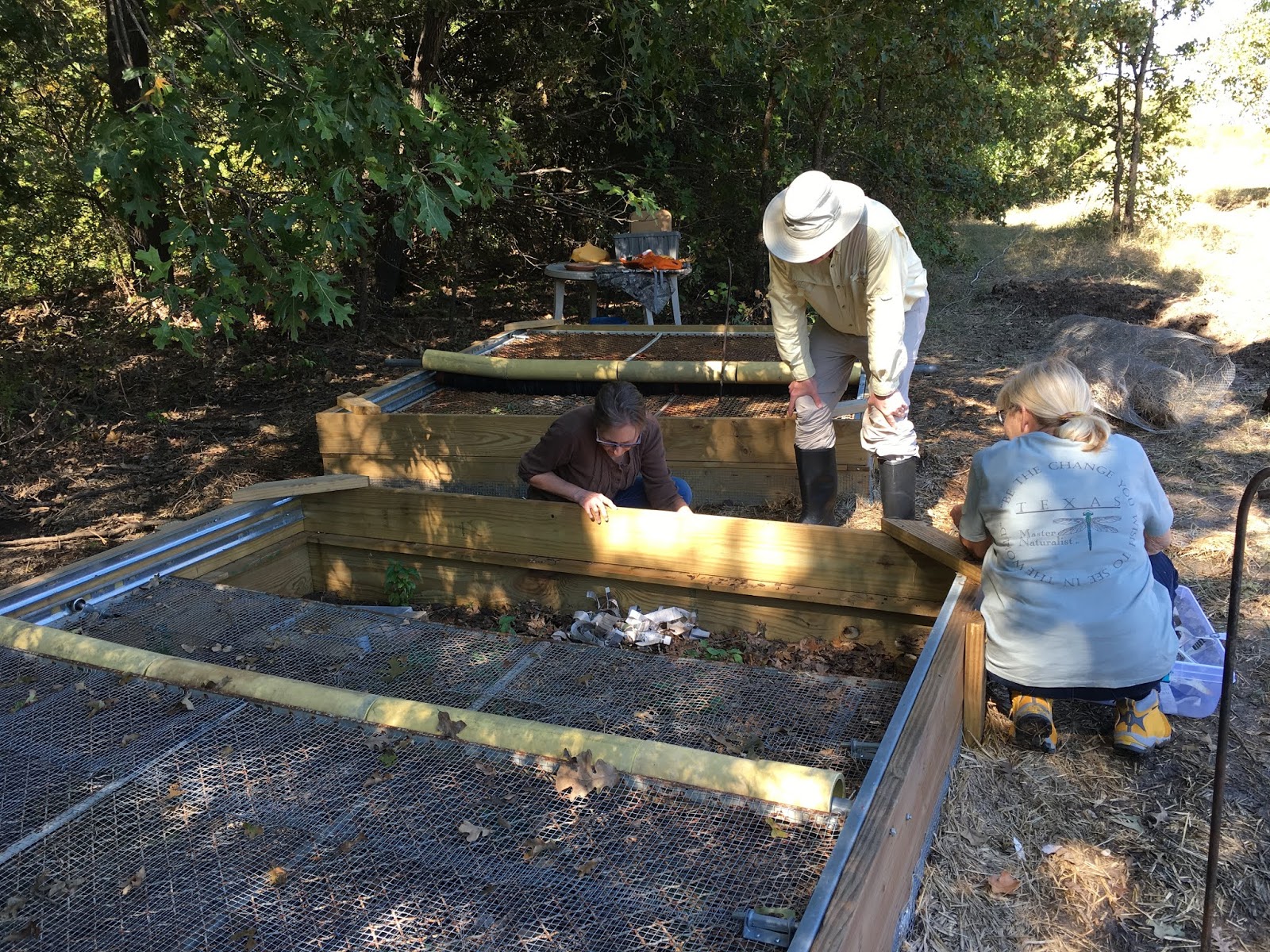
Rather than being part of the trackers, we ended up working on the maintenance (i.e. feeding and watering) of some young turtles that are being raised in pens at LLELA and will be released at some time in the future.  Box turtles do not relocate well.  If found in one location and released they will try to return to their original home territory.  Since this typically requires crossing streets and and other man made structures, this usually does not turn out well for the turtles.  The idea for the current experiment is to raise the young turtles in pens at LLELA, hopefully establishing LLELA as their home territory.  When they are large enough to be better able to survive predation (maybe as much as 3 years old), they will be released at LLELA.  We helped release the turtles into their pens in late October.

The Frog and others watch the little turtles as they are released into their new pen at LLELA.  Notice Frog's tall mud boots.

We also signed up to feed and water them once a week, but only did that a couple times due to the heavy rains before the turtles went into hibernation (actually brumation) for the winter.  I presume we will resume feeding and watering them this spring after it gets warm.

iNaturalist postings.  Despite the rain, we were still able to get out fairly often to walk, usually with a camera so we could document our nature sightings on iNaturalist.  The end of year summary of our activity on iNaturalist indicated we recorded 2163 observations of 461 different species in 2018.  At the bottom of that summary page you can click on the "newly added" each month to see the species we recorded for the first time.  BTW, the small pictures at the top of the summary page and all of the pictures that come up when clicking are our pictures (meaning primarily the Frog's).  We started posting on iNaturalist as part of the 2017 City Challenge in April 2017.  Needless to say, we got hooked and are enjoying even more now that iNaturalist helps us identify what we observe.

Using my new camera.  I mentioned in my last post that I had gotten a new camera in September.  I am still learning how to use it, but am getting better.  With its super zoom it is a great complement to Frog's better camera, but with less reach.  It is best in bright light.


Goldfinch at the top of a very tall tree. (https://www.inaturalist.org/observations/19730012)  I only saw it without the camera because I saw it land.  (Nikon P1000: 1/500 sec, f 5.6, iso 220, 1200 mm 35mm equivalent)


Pie-billed grebe on the river. (https://www.inaturalist.org/observations/19729961)  (Nikon P1000: 1/500 sec, f 8, iso 320, 3000 mm 35mm equivalent)


I will never be able to get the great pics the Frog gets, especially of action shots such as birds in flight.

 
Ring-billed gull (https://www.inaturalist.org/observations/18756340)
(Nikon D850: 1/1000 sec, f 8, iso 220, 400 mm)


Pelican coming in for a landing  (https://www.inaturalist.org/observations/18983740)  The pelicans love the large outflow on the river...lots of stunned fish coming through with the gush of water make for easy pickings. 
(Nikon D850: 1/2000 sec, f 6.3, iso 360, 400 mm)


However, even in overcast conditions, my camera sometimes turns out to be useful if the subject sits still since it has such a great zoom.

Not the greatest picture, but good enough considering he was very far away on the top of a tall electric tower.  (https://www.inaturalist.org/observations/18764052) 
(Nikon P1000: 1/250 sec, f 7.1, iso 400, 2600 mm 35mm equivalent)

Trip to Santa Barbara.  All of the activities above were great, but by far the highlight of the year was a trip to Santa Barbara for Christmas.  As usual I usually forget to take pictures even though my phone is always in my pocket, but I still grabbed a few.

The best part of the trip is, of course, just seeing Paul and Gwen and catching up with all of their many activities..  There were also many activities to keep us busy while we were there.


There was cookie making, to go along with the fabulous gourmet meals.


Explaining some of the intricacies of medieval garment construction.  Both Paul and Gwen were elevated to peerages this year, a very high honor in the Society for Creative Anachronism. 


There is always armor to inspect


But a highlight this year was meeting the new grand kitties.

Marlowe, the male flame point Siamese, isn't quite ready to wake up after finding a new place to hang out. 


Sidney, a female tuxedo, checking out the water left in the bathtub

We ended up staying two extra days after our flight was cancelled due to storms in north Texas.  I am sure that was a pain for Paul and Gwen (sorry guys), but it gave us some more time to explore the hiking trails in their neighborhood, eat at a fun German restaurant (Dutch Garden Restaurant, which according to TripAdvisor is the oldest restaurant in Santa Barbara), and allow the kitties to get more comfortable with us.

2.19 mile walk according to the gps in my phone.  There was more vertical change to the walk than apparent from this view, but we missed the biggest part of that because we wrongly turned around too soon.

By the end of our visit, both Sidney and Marlowe had overcome much of their shyness...especially when there were important things to do such as following a reflection around the room