Thursday, July 14, 2016

Captive Cantaloupe

Not much new is happening on the home front.  One of the main activities continues to be the garden and all things associated with it.  It may be a matter of wishful thinking at this early stage in the process, but I have begun researching various canning and pickling processes that I want to try if and when I get some veggies later this fall.

It is a bit of a struggle to grow things this time of year with the extreme heat and high winds, as well as some unexpected thunder storms several weeks ago.  The pepper plants in particular are showing the stress of these non-ideal conditions--plus the stress of my good intentions but poor treatment due to my inexperience.  I have especially been agonizing over whether I am watering them too much or too little.

Although I look at them multiple times a day, I was surprised to see how much the plants had grown when I looked at before and after pictures this morning.

Garden on Fourth of July

On July 4 the pepper plants were newly staked to help them stand up to the wind, but they reached to less than half of the above ground height of the stakes or less than 18 inches.  The tomatoes were also doing fine, but small.

This morning--July 14
As of this morning at least one of the pepper plants is two feet tall and one of the tomato plants (Super Sweet 100 cherry tomato) is already taller than one of the shorter pepper plants.  Despite their droopy leaves, I guess the plants are doing better than I thought.

However, the biggest difference is in the size of the cantaloupe plant.  It started out under one cage to protect it from the neighborhood bunnies.  After it quickly outgrew that cage, I replaced it with a larger and taller cage (another inverted old wire shelf). The original cage was next to it to block the large opening on one side.  Even this larger cage was very quickly too small.


Overnight growth of the cantaloupe through the cage
Last night the cantaloupe leaves were all inside the cage and not that close to the edge.  This morning the end of the vine had grown enough that the new leaves that had developed overnight were outside the cage.  These garden cages are clearly no longer sufficient for this cantaloupe plant, which has world domination, or at least garden domination, on its mind. 

The next step up was a 2' x 2' by 18" high cage made from pvc coated "poultry netting", the official name for what I and probably 99% of the rest of the world call "chicken wire".  I found the pvc coated chicken wire on the web and FedEx delivered it earlier this week.  This morning I cut the roll into the appropriate sizes with tin snips and wired everything together with zip ties.  I wasn't sure what to expect, but it was not hard to cut and the pvc coating made it relatively easy to handle.  Chicken wire has a bad reputation for being nasty to work with.  That was not the case with this stuff.  I didn't even have to use gloves.

Finished chicken wire cage over cantaloupe plant

This is the first of multiple garden cages, although the others will likely be much smaller.  My plan is to protect the plants while they are small from the rabbits.  Hopefully by the time the plants outgrow their respective cages, they will be less interesting to the bunnies. 

We have not seen the rabbits in the yard recently, but we assume they are around since we have seen more this year than anytime since we have lived in Texas.  We walk about 3.5 miles each morning on one of two loops through the neighborhood.  In the past two weeks we have seen at least one rabbit every day and as many as six, although a total of 3-4 is more typical.  They are not grouped together in one location.  If we are seeing this many as we walk through the neighborhood, I can't imagine how many are actually out there.

By the way, rabbits are not the only critters we see.  The rabbits are usually too far away for a picture, but we did encounter a large (at least it seemed large to us) snapping turtle along the edge of the sidewalk on one of our recent walks.  You can't tell from this picture, but his shell was over a foot long.  We did not get too close, but I expected him to retract into his shell when we got closer.  Instead he turned toward us.  According to this educational video, snapping turtles cannot pull their legs into their shell. 

Turtle next to the sidewalk.

The birds are too numerous to count, but Mississippi kites are frequent right now.  We even see the occasional waterfowl.

Ducks in the median


It is clear there is no shortage of wildlife in the area and most of them are hungry.  A Facebook group I follow, North Texas Vegetable Gardeners, has had reports of many different critters helping themselves to garden produce including squirrels and birds attacking the tomatoes and opossums eating the cantaloupe.   I just hope I can keep them out of my garden.

Friday, July 1, 2016

To Parsnip or Not to Parsnip

When I came up with the original plan for the vegetable garden, I was focused on relatively simple things to grow (since I have no idea what I am doing) and things which we would use.  Somewhat unusual among the chosen plants were parsnips.  However, I had stumbled upon a roasted veggie recipe at Thanksgiving time last year.
 
Recipe from 11-18-15 Dallas Morning News

It was easy to fix and was really good.  The only major challenge was finding the parsnips.  Tom Thumb did not seem to have them, at least when I first fixed this recipe.  I found them at Whole Foods, but knew they were unusual when the checkout clerk at Whole Foods was stumped and had to ask me what they were.


Based on that experience, I thought they might be a good candidate for growing in our garden.  Of course, I did the appropriate Google search before making a final decision.  Multiple sites indicated they are easy to grow as long as fresh seeds are used.  I even found someone in Denton that had had success.  They take a VERY long time to mature, 95-105 days according to the seed packet I have-but could be 50 or 60 days longer for some varieties.


Planting of parsnips in Texas is in fall with harvest in March.  That is important for the total length of time, the cooler weather in general, and finally the need for some really cold weather (frost or freeze) that causes some of the starches to change to sugar, producing the sweet nutty flavor. 

Although I did not see mention of this on the other growing sites, I did note the following disclaimer on the blog post from the grower in Denton:
Warning: The leaves and stems of parsnips contain a juice that can cause Phytophotodermatitis in some people. Phytophotodermatitis happens when the sun interacts with the juice on the skin causing a reaction that resembles sunburn spots. These spots can also develop blisters. This is much less of a concern for garden parsnips compared to wild parsnips, but just to be cautious I wear rubber gloves while harvesting parsnips and do not wipe my face or eyes during the process.

I did not think a lot about that other than to plan for gloves and long sleeves when working with the leaves.  How bad could it be?  I routinely survive poison ivy outbreaks after hiking in the woods.

Yesterday I stumbled across this post on Facebook about a woman in Iowa and her run in with wild parsnip that required a trip to the emergency room.  Admittedly this was "wild" parsnip, but I thought I would do some more investigation.  Googling "burns from parsnip" produces hundreds of hits.  Hmmmm...I might need to look into this some more.

The best discussion I found about what actually happens was this article in the North Woodlands magazine.  Although many different plants besides parsnips (e.g. poison ivy, poison oak, nettles) have developed chemical defense mechanisms, parsnip poison and the phytophotodermatitis that it causes is fundamentally different from poison ivy:

The toxin in parsnip sap is different from the toxin found in poison ivy or poison sumac; the reaction your body has to it has nothing to do with your immune system, and everyone is susceptible. The harmful chemical compounds – specifically, psoralen and its derivatives – are photosensitizing, which means they’re activated by ultraviolet radiation from the sun. (Smear yourself with parsnip sap in a dark closet, and nothing will happen.)
When you get some sap on your skin, the sap absorbs solar energy, then releases it in the form of heat. On a micro level, the psoralen molecule lodges between two strands of DNA, and sunlight fuses the strands together. “You can imagine what this does to an insect that tries to eat the plant,” says Vogelmann.
The chemical reaction damages skin cells and feels very much like a burn. This is a key difference between the phototoxic dermatitis caused by poison parsnip and the allergic contact dermatitis you get from poison ivy. Parsnip burns feel like burns, whereas poison ivy rashes are often more itchy and irritating than painful.
While the pain from a parsnip burn is relatively short-lived, an encounter can leave long-lasting scars. As part of the recovery process, the body produces dark pigmentation that is thought to serve as a protective mechanism against further UV injury (sort of a super-suntan). These dark splotches can linger on the body for years. In an interesting twist, people with psoriasis and similar skin-pigment disorders sometimes turn the toxin to their advantage and use psoralens to help increase their skin’s sensitivity to ultraviolet light.


A variety of plants in the carrot family (parsnip, parsley, celery, hogweed, carrot, and wild carrot) can cause phytophotodermatitis.  Some of these are not much of a problem, but some can be quite serious.  The worst is giant hogweed, which can grow up to 14 feet tall and is very dangerous, causing severe phytophotodermatitis and even blindness due to its large amount of sap.  Fortunately giant hogweed does not grow in Texas!

So what does all of this have to do with parsnip in the garden and is it dangerous?  Apparently some field workers picking domestic parsnip and even produce workers in grocery stores have developed phytophotodermatitis from domestic parsnip greens.  Yes, it can leave lasting scars.  Could I work around the problems?  Yes, I am sure I could.  It is far less dangerous than many of the things I dealt with in the lab.  However, I am not sure it is worth it this first year when so many other things are new.  There are also additional hazards of working with such a plant in the crowded environment of a square foot garden.  I think I will pass this year.  I am only out the $1.69 for the packet of seeds.  Maybe in another year or two, when I know more about what to expect, I will give parsnips a try.

Sunday, June 26, 2016

Fall Tomato Plants are Planted

Although it has been a bit of two steps forward and one step back, we continue to make progress towards our fall garden. 

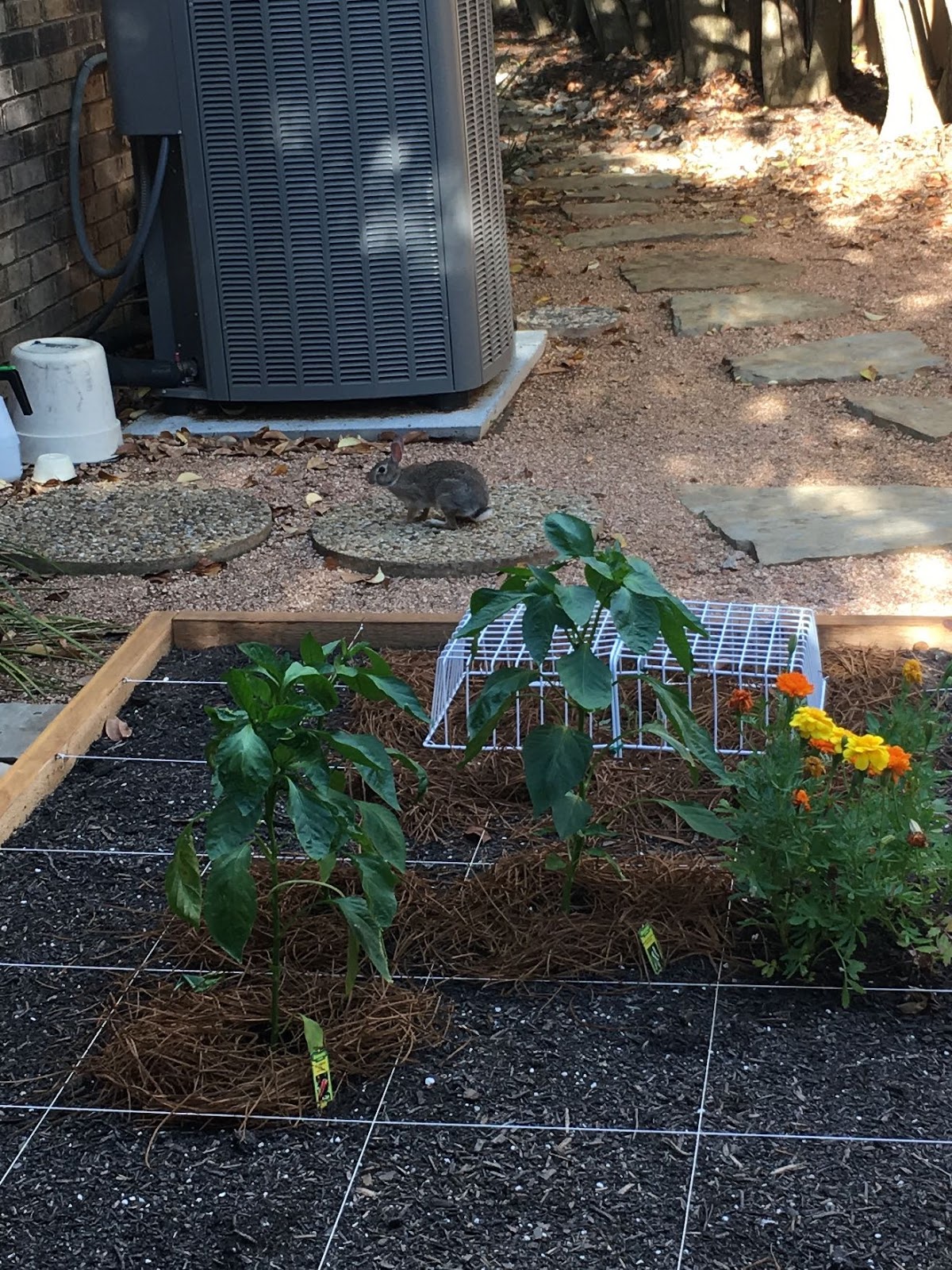
New cantaloupe plants.  After the rabbits (or something) ate the first two cantaloupe seedlings, I planted two more cantaloupe seeds.  However, this time I covered the seedlings with an old metal wire shelf that we had lying around and not being used.  It is actually two shelves zip tied together and fastened down with garden staples.  The plan is to leave this in place until the plants are larger and hopefully less susceptible to rabbit attack.  Presumably young seedlings and tender leafy plants such as lettuce will be of more interest to the rabbits than larger cantaloupe vines.


I still do not have definitive proof that it was the rabbits that ate the plants, but I certainly have lots of circumstantial evidence.  One evening I went out after dinner to check on the plants and was nearly scared to death when a rabbit went running past me from the plants behind the bench.  Yes, I am sure he may have been more scared than me, but he did not act like it.  He stopped and turned around to look at me.  His attitude was more that of  "why are you here bothering me?".


The good news is that the new cantaloupe seeds germinated in only three days, so this has only set the cantaloupe harvest back about two weeks.  Estimated time to maturity is 85 days or mid-Septemberish.  Of course, that is assuming we get any harvest at all and I don't kill the plant in some way before then.

Pepper plants.  The pepper plants are growing.  Four of the five either currently have or have had blossoms.  The banana pepper is growing the most, but has not yet made any blossoms. 

The really exciting part is that one of the plants (Big Bertha) has two small baby peppers. 

Baby bell peppers on Big Bertha plant

Unfortunately, the Big Bertha plant is also the one that seems to be in distress and keeps dropping leaves.  I don't know if it is from too much water, too little water, or heat issues.  I hope I don't kill the plant before the peppers are usable.

Tomato class in Dallas.  On Saturday we went to a Fall Tomato class at North Haven Gardens in Dallas.  It is a long ways to go (near SMU), but NHG has beautiful plants chosen specifically for north Texas.  They have a good selection of seeds and various accessories.  Their staff is also knowledgeable and tolerant of my many questions.

I am glad I had done research ahead of time or I would have been totally lost in the class.  As it was, I learned a lot and hopefully picked up some important tips on how to properly plant the tomato plants.

One of the things that I did learn was that the entire garden, not just the areas planted, should be mulched and kept watered.  Otherwise the high temperatures from the sun will kill all of the important bacteria and other living components in the soil.  It makes sense, but I had not considered it since to me dirt is dirt.

New tomato plants.  Based on our research and the class, we bought four tomato plants which we planted this morning. The four tomato plants include three different varieties:  Supersweet 100, Fourth of July, and Paul Robeson.

Four tomato plants behind two pepper plants


All three varieties are indeterminate, i.e. vining as opposed to bush types.  Indeterminate tomato plants can be grown in only one square foot each since they can be made to grow on the trellis.  Bush or determinate varieties require nine square feet each. 

Supersweet 100  are very sweet cherry tomatoes, what my tomato book calls "tomato candy", with an estimated maturity of 63-70 days.   The Fourth of July plants produce small (4 oz) tomatoes, but reach maturity in only 49 days.  If planted in the spring they mature by Independence Day, hence the name.  The Paul Robeson plant will be an experiment.  It is an heirloom variety (90 day maturity).  Since it is an heirloom it is probably more susceptible to disease, but it apparently has a strong cult following among tomato experts due at least in part to its taste.  I hope it survives, because it will be great to have some tomatoes that have more taste than what is sold in the grocery store.

I am not sure any of these maturity times take into account our hot summer temperatures.  Most tomato plants will not set fruit until the temperatures are below 92 during the day and 75 at night.


Beginning to look more like a real garden

Even if the tomatoes do not produce fruit any time soon, at least the garden is slowly taking shape and looking more and more like a real garden.  The challenge for the next month will be to keep everything watered, but not over watered.

Next round of plantings.  The tomatoes are the last of the plants to be transplanted.  Everything else this year will be from seeds, all of which we got while at North Haven Gardens.  These will be planted at various times, but the first big planting will be on August 1.  On August 1, we will plant bush beans, wax bush beans, pole beans, zucchini, and broccoli. 

Since all of the remaining plantings will be from seeds and hence produce little seedlings, I have to figure out how to protect them from the rabbits.  Possibilities include more garden cages similar to what is over the cantaloupe or a fence around the entire garden.  Both have advantages and disadvantages, so I am not sure how to proceed.  Stay tuned.