Saturday, June 17, 2017

College Street Egret Rookery

Where do cattle egrets go to build their nests?  In Lewisville, that is apparently the neighborhood pool park on College Street, now known as Wayne Frady Park


We had heard about this rookery on the news and in the paper, but did not know what to expect.  On our way home from LLELA earlier this week we decided to swing by and take a look.  We are glad we did.  

Dozens or perhaps hundreds of birds, mostly cattle egrets, have crowded into the trees near the back of this small park and built nests on what seems to be every possible space.  
 
Each of the "clumps" in the tree is a nest

The rookery is a real nuisance to the people in this neighborhood, but it was very interesting to see.  It is also very accessible, with the viewing spots a short walk down a sidewalk from the parking lot.

There were birds scattered throughout the trees, most squabbling over space.


  Of course there were birds on each of the nests.

Cattle egrets sitting on their nests
 
In addition to the birds in the trees, there was a steady stream of birds flying into and out of the area carrying sticks...presumably making more nests. 
 
The area under the trees was blocked off, but it was easy to see at several breaks in the overgrown bushes that there were dozens more birds on the ground.

Birds in the open space under the trees

Cattle egrets are not small birds.  They are 18-22 inches long and have a wingspan of 3 feet or more. 

Cattle egret with non-breeding yellow beak and legs

 
Cattle egret with the pink legs and pink on the beak of breeding season


We will likely visit again.  We are sure the birds will be there for awhile.  By federal law (the Migratory Bird Treaty Act of 1918) once nests are established nothing can be done to disturb the birds.  The birds will leave on their own at the end of nesting season, but that may not be until November.

Friday, June 2, 2017

Using iNaturalist


I wrote extensively in April about the City Nature Challenge (Parts 1, 2, 3, 4, and 5), a competition among the citizens of selected cities to post nature observations.  The competition used the site iNaturalist.org, a place for citizen scientists to post observations of animals and plants.

I did not think we would use iNaturalist much after that, but I was wrong.  Since then we have begun to use iNaturalist routinely.  We are finding it useful for a number of reasons.

How is it useful?
Recording our nature observations.  iNaturalist is a means of recording what we see during our walks, particularly at LLELA.  For example, here are the most recent 30 observations we have recorded.  It should be possible to click on any one of the pictures to see the details of that observation. (BTW, all of these are the Frog's pics.)


Alternatively, click on the link below to see all of our observations.  


Better yet, what I like to do is to go to the iNaturalist calendar for our finds and click on the date to see what observations we recorded on that day.  Each of the pictures is a link to our full observation.  That includes not only a picture or pictures, but a map of where we made the observation and points on the map for other people's observations of the same thing.  It takes "scrapbooking" of our nature adventures to a whole new level!!  

Seeing what other people are doing.  What has been surprising to me are some of the other uses of iNaturalist beyond just recording our finds.  Since other people also use it, it gives us a way to see what other people are observing and where.

I routinely look to see what others have reported at LLELA.  Seeing their observations has made me aware of many many things I did not know even existed. 

For example, we were well aware of great blue herons.  We see them all the time at LLELA and at Lake Park.


Great Blue Heron

However, based on other people's reports we became aware of several other types of herons.  For anyone that has routinely been around water and marshes these may seem common place, but we had no idea these other birds existed.  Seeing other people's posts introduced us to the different species and gave us an incentive to look harder to see if we too could find them.  It has been a great adventure. 

Green Heron--yea, it is not really very green, but that is its name.


Yellow-Crowned Night Heron -- He must be asleep; he is standing on one leg.


Little Blue Heron


Learning more about what we are seeing.  Finally, and probably most importantly, for newbie naturalists like us, iNaturalist is an aid to identifying what we see.  Once we post our identification, whether only generally (bird) or a specific specie (yellow-crowned night heron), we get feedback on the accuracy of our identification.  That is especially important when I mess up and get the ID wrong.  It is really helping us learn. 

Dragonflies.  For birds or for many butterflies identification is not too bad.  It just takes time.  However, for dragonflies and damselflies, the input from experts has been essential.  A few of the types of dragonflies are readily identifiable.  Among the easiest for us are the Eastern Pondhawk and the Common Whitetail, both of which we see in great abundance.  Even with these they were tricky at first because the genders look so different. 


male Eastern Pondhawk

 
female Eastern Pondhawk


male Common Whitetail dragonfly


female Common Whitetail dragonfly

 
juvenile male Common Whitetail dragonfly (the wings of the male but the abdomen of the female)


Some of the others I find confusing.  Even though the male and female within a species look totally different, one may look nearly identical to another totally different species.  For example, male and female Blue Dashers are totally different, but I still sometimes confuse the male Blue Dasher with the male Eastern Pondhawk. 


male Blue Dasher dragonfly

I always have trouble differentiating the female Blue Dasher and the female Great Blue Skimmer.  For them it seems to come down to leg color and color on the sides of their thorax (chest).  That assumes, of course, that the pictures are good enough to make such differentiation.  Sometimes the critters don't cooperate with the perfect pose to make these distinctions.

 
female Blue Dasher dragonfly


female Great Blue Skimmer dragonfly
 
Damselflies.  That does not even address the damselflies, which I find another order of magnitude more difficult to identify in many cases since there are so many species that are very similar looking.  Despite that, they are so neat and so little...often only an inch or so in length...they are still worth the effort.

Fragile Forktail damselfly


Blue-ringed Dancer damselfly -- You can see how tiny he is (about 1.25" total length) next to the screw in the decking of the bridge


Blue-fronted Dancer damselfly


The Amazon elves have brought me a whole series of new guide books which are incredibly helpful.  However, having input through iNaturalist from lots of experts has really helped.  Most have been very patient with me since I think they know I am trying....and, of course, they can see the Frog usually supplies really good images.

Hopefully you can tell I am having loads of fun with this.

Wednesday, May 17, 2017

May Wildflower Walk at LLELA

On Saturday, May 13, we went on a guided Wildflower Walk at LLELA led by the director of LLELA, Dr. Ken Steigman.


After meeting at the pavilion, we (four cars of ten people total) caravaned behind Dr. Steigman eastward through the normally locked gate at the dam outflow to some of the far eastern parts of the preserve.  This area is often referred to as the "bison prairie", since it is where LLELA used to maintain a bison herd.

Gps track of drive and walk to Wildflower Walk.  Red flag is the pavilion.  Gate is at the river.  Blue flag is where we parked,  just east of the "main" road (Fish Hatchery/Holfords Prairie Road).  To help with the scale, it is 2.3 crow miles between the red and blue flag.  It was about a 0.4 mile walk from the parking spot to our farthest point east.


As explained by Dr. Steigman, this area was a "borrow pit" or area where dirt was "borrowed" by the Army Corps of Engineers last year to repair the dam.


As part of the reclamation of the area, it was reseeded last fall.  It is mostly the annual wildflowers that have taken hold so far.  The ground cover is not very thick yet, since the warm weather grasses and perennials have yet to take off, but that made the meander through the prairie easier than it might have been otherwise.   However, that in no way detracted from the stunning array of color.


The predominant flowers were lemon beebalm and Indian blanket, with a fair amount of clasping coneflowers thrown in.

Indian blanket, lemon beebalm, and clasping coneflowers

When crushed, the leaves of the lemon beebalm smell very minty, the reason the plant is also called purple horsemint.

Indian blanket


Lemon beebalm and clasping coneflowers
The clasping coneflowers (what we had erroneously thought previously were black-eyed susan) are so named for how the leaves clasp the stem.

I thought I knew what a thistle was.  Mostly I do.  However, there are many kinds of thistles and all thistles have prickly leaves.

Thistle

A flower that looks similar to a thistle is the basket flower.  The flower is similar looking, but the bud looks like a woven basket.   Although the bud looks like it might be prickly, it is not.  This plant is not a thistle.

Basket flower, NOT a thistle


Bud of the basket flower that looks like a basket, hence the name.


There were lots of other flowers sprinkled in.

Some type of coreopsis --  note the round flower buds

One plant with a very showy pink blossom had mimosa-like leaves that curled up when touched, a so-called "sensitive plant".


A type of sensitive plant, possibly Roemer's sensitive brier.
 
There were also butterflies and other critters, although not as many as I would have imagined given the number of flowers.


Checkered white butterfly on an Indian blanket.  Note the butterfly's long proboscis


Eastern tailed blue butterfly (so-named due to the tiny tails at the bottom of the wings) on a yet unidentified flower that I think may be diamond-flowers.


Although the flowers were beautiful, there was a lot of drama going on at the micro level.  We saw many lady bugs chowing down on aphids.

We saw a crab spider that had captured a honey bee on a milkweed plant.  Unlike many spiders, that build webs to trap their prey, this spider is camouflaged and attacks when the prey lands nearby.  I was amazed that the spider could take on something so much larger than he was.


Honey bee captured by a crab spider on a milkweed plant.


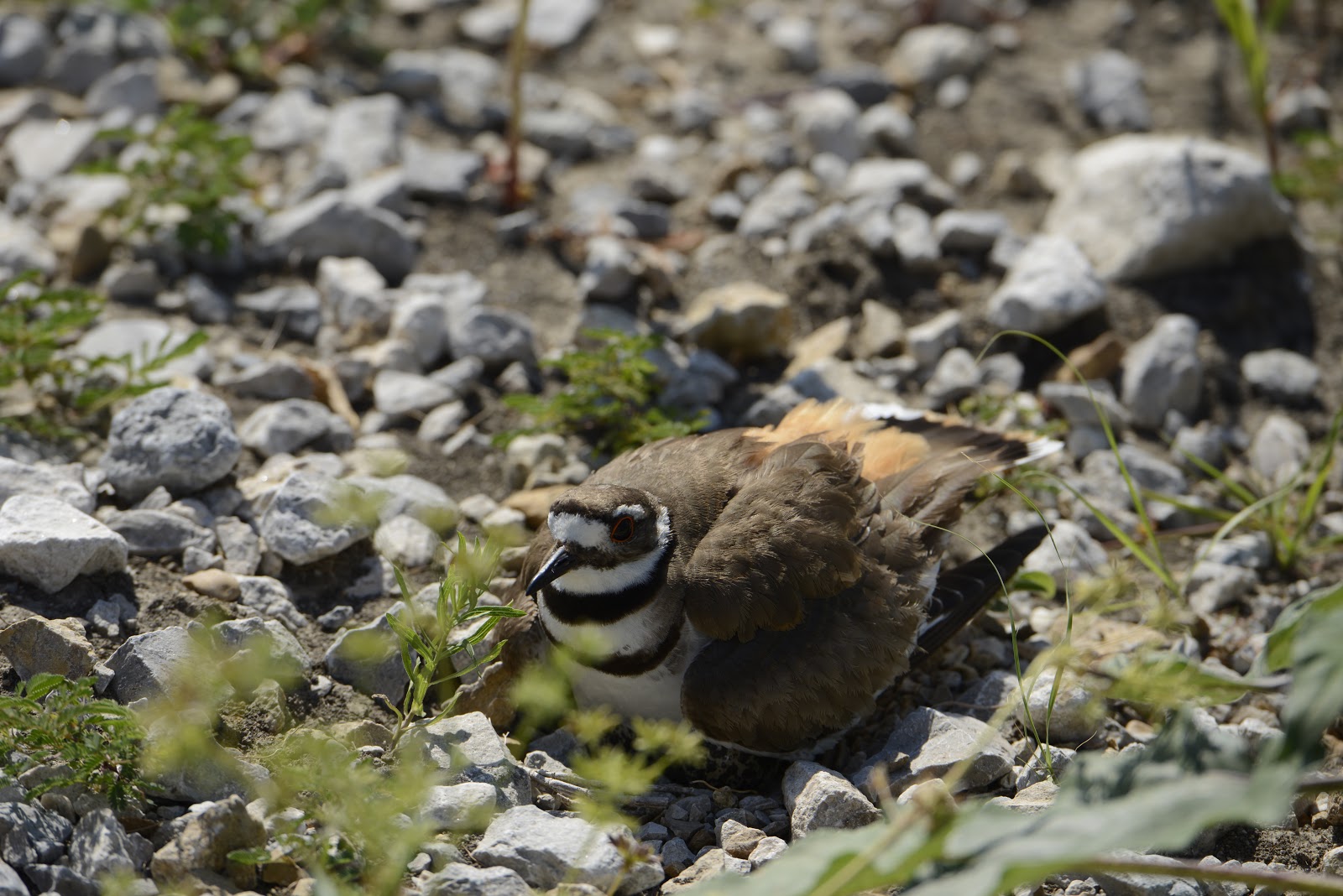
Perhaps appropriate for Mother's Day weekend, we also saw a very brave mother killdeer who held her ground on her nest.  We nearly stepped on her since she was along the side of the road in the gravel.  I did not see them, but some others in the group saw her eggs.  It is apparently common for killdeer to lay their eggs among the gravel since that makes them somewhat camouflaged.  Dr. Steigman indicated he occasionally sees them with their eggs in the middle of the gravel road rather than at the side...bird brains!

Killdeer along the side of the road

I have not done justice to the large number of different flowers we saw.  I won't try to document everything.  I don't remember the names of everything anyway.  I have posted many of our observations...at least the ones that we got pictures of...on iNaturalist.org.  (Click here to see our iNaturalist observations.  Those on May 13 were all from this trip.)

In any case, with the great show of flowers and the perfect cool weather it was a great trip.

Wait, what is that person on the road below the dam doing?


Photographer for the group pic

Had to take the group pic!


Wild Flower Walk participants, courtesy of Larry Brennan.


Dueling Telephotos, with permission of Larry Brennan.