Tuesday, January 22, 2019

A long post for a long time without a post

Lots of rain.  I knew that it had been a long time since I had posted here, but did not realize how long until I looked this morning...4 months!

We have continued to be busy, but nothing seemed worthy of a long report due to a number of things:

The fall garden was a total bust as the newly sprouted seedlings from the fall planting were flooded out by torrential rain.

We continued to walk at LLELA when we could, but that was not very often due to repeated torrential rain followed by months of flooding from the heavy outflow from the dam.

We did not take the RV out due to flooding in many Texas state parks and hence closing of the campgrounds, not to mention the continued forecast for more rain.

I think you can sense a common theme.  Even though I mentioned the rain in my previous post in September, the rain continued throughout the fall.  In fact, this meteorological fall (September-November) with 29.21 inches was by far the wettest on record in DFW.  Second (in 2015) was a "mere" 21.82 inches.

Totals above are through November.  With additional rain in December, 2018, the total for the year was 55.97" or second on the list of wettest calendar years.


Despite drought conditions during summer 2018, the record autumn rainfall added to record rainfall in February, 2018 (11.31" vs the previous high for February in 1997 of 7.40") resulted in a flooded Lewisville Lake. The lake did not overflow the spillway like it did in 2015 (thank goodness!).  However, it did result in closing of Lake Park in Lewisville for an extended period of time. It also meant the Corps of Engineers had to let water out through the outflow at very high rates for months. 

Flooding of LLELA.  High outflow rates from the lake mean flooding of much of LLELA.  The "normal" gauge height of the river under normal outflow rates is about six feet.  By the end of October, it had hit a high of just under 25 feet.  Much of the Bittern Marsh Trail, the campgrounds, and essentially all of the Redbud Trail have been under multiple feet of water for months.

We did make our way through the mud and yuck along part of the Bittern Marsh Trail on October 1.  The picture below is of the high blind from across the marsh.  The floor of the high blind (which is just barely above the level of the marsh in the picture) is at least 5 feet above the boardwalk.  The gauge height of the river that day was 22 feet or three feet lower than its maximum height later in the month.

High Blind on Bittern Marsh on October 1, 2018 from across the marsh, the closest we could get without wading through heavy mud or water. The high water is due to the river backing up into the marsh.  The floor of the blind is many steps (at least five feet?) above the level of the boardwalk.


Low Blind on Bittern Marsh on October 1, 2018 from across the marsh.  The top of the green screening around the blind is about chest high. The river several weeks after this was about 3 feet higher, which we presume would have put the water near the roof the blind.


Even today (January 22) Lewisville Lake is STILL not back to the conservation level so the outflow levels are still high.  Hopefully the lake level will be back to normal as soon as later this week, meaning the outflow rates will return to normal, the river will return to its banks, and the trails can begin to dry out.  Operative word of course is "begin".  It will be a very long time for some of the trails to be passable after months under many feet of water.

What have we been doing??  I have hinted about what we have NOT been doing.  So what have we been doing??

Turtles.  We volunteered to help with the Box Turtle Recovery Project at LLELA.  Although probably not typical, three-toed box turtles can live to be 50-100 years old.  Despite that, they are becoming increasingly rare in the area.  It is not understood why.  This project aims to turn around the declining population by tracking the existing turtles at LLELA to better understand their behavior and by releasing new turtles.  

We originally thought we would be part of the tracking team and took the training in June to learn how to track the released turtles.  At least our small time with that part of the project showed us that the existing turtles at LLELA can cover many miles within the park over very rough terrain.  Work elsewhere suggests that box turtles commonly follow a seasonal route connecting known food sources.  Time will tell whether that is true here.

Rather than being part of the trackers, we ended up working on the maintenance (i.e. feeding and watering) of some young turtles that are being raised in pens at LLELA and will be released at some time in the future.  Box turtles do not relocate well.  If found in one location and released they will try to return to their original home territory.  Since this typically requires crossing streets and and other man made structures, this usually does not turn out well for the turtles.  The idea for the current experiment is to raise the young turtles in pens at LLELA, hopefully establishing LLELA as their home territory.  When they are large enough to be better able to survive predation (maybe as much as 3 years old), they will be released at LLELA.  We helped release the turtles into their pens in late October.
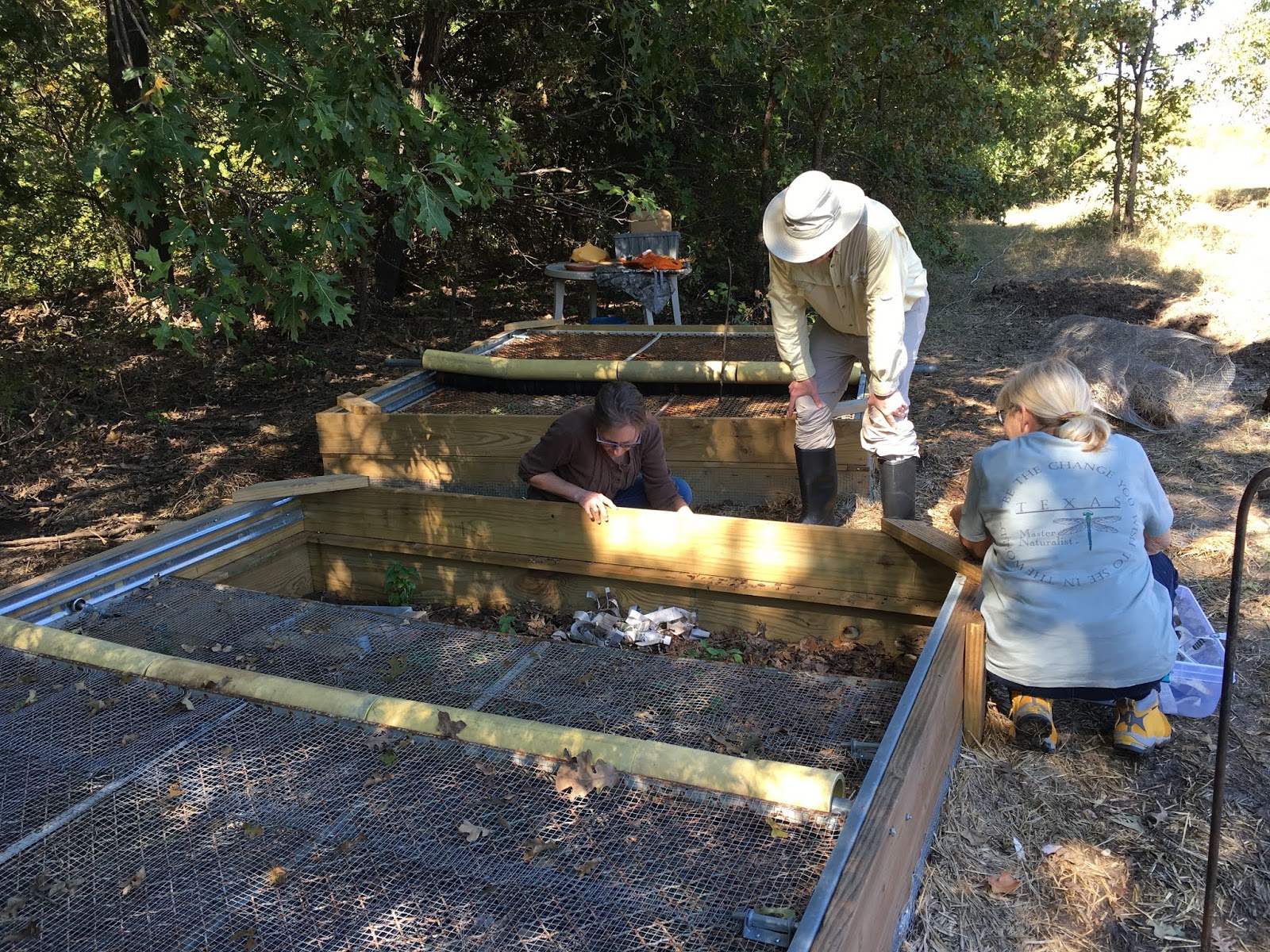
The Frog and others watch the little turtles as they are released into their new pen at LLELA.  Notice Frog's tall mud boots.

We also signed up to feed and water them once a week, but only did that a couple times due to the heavy rains before the turtles went into hibernation (actually brumation) for the winter.  I presume we will resume feeding and watering them this spring after it gets warm.

iNaturalist postings.  Despite the rain, we were still able to get out fairly often to walk, usually with a camera so we could document our nature sightings on iNaturalist.  The end of year summary of our activity on iNaturalist indicated we recorded 2163 observations of 461 different species in 2018.  At the bottom of that summary page you can click on the "newly added" each month to see the species we recorded for the first time.  BTW, the small pictures at the top of the summary page and all of the pictures that come up when clicking are our pictures (meaning primarily the Frog's).  We started posting on iNaturalist as part of the 2017 City Challenge in April 2017.  Needless to say, we got hooked and are enjoying even more now that iNaturalist helps us identify what we observe.

Using my new camera.  I mentioned in my last post that I had gotten a new camera in September.  I am still learning how to use it, but am getting better.  With its super zoom it is a great complement to Frog's better camera, but with less reach.  It is best in bright light.


Goldfinch at the top of a very tall tree. (https://www.inaturalist.org/observations/19730012)  I only saw it without the camera because I saw it land.  (Nikon P1000: 1/500 sec, f 5.6, iso 220, 1200 mm 35mm equivalent)


Pie-billed grebe on the river. (https://www.inaturalist.org/observations/19729961)  (Nikon P1000: 1/500 sec, f 8, iso 320, 3000 mm 35mm equivalent)


I will never be able to get the great pics the Frog gets, especially of action shots such as birds in flight.

 
Ring-billed gull (https://www.inaturalist.org/observations/18756340)
(Nikon D850: 1/1000 sec, f 8, iso 220, 400 mm)


Pelican coming in for a landing  (https://www.inaturalist.org/observations/18983740)  The pelicans love the large outflow on the river...lots of stunned fish coming through with the gush of water make for easy pickings. 
(Nikon D850: 1/2000 sec, f 6.3, iso 360, 400 mm)


However, even in overcast conditions, my camera sometimes turns out to be useful if the subject sits still since it has such a great zoom.

Not the greatest picture, but good enough considering he was very far away on the top of a tall electric tower.  (https://www.inaturalist.org/observations/18764052) 
(Nikon P1000: 1/250 sec, f 7.1, iso 400, 2600 mm 35mm equivalent)

Trip to Santa Barbara.  All of the activities above were great, but by far the highlight of the year was a trip to Santa Barbara for Christmas.  As usual I usually forget to take pictures even though my phone is always in my pocket, but I still grabbed a few.

The best part of the trip is, of course, just seeing Paul and Gwen and catching up with all of their many activities..  There were also many activities to keep us busy while we were there.


There was cookie making, to go along with the fabulous gourmet meals.


Explaining some of the intricacies of medieval garment construction.  Both Paul and Gwen were elevated to peerages this year, a very high honor in the Society for Creative Anachronism. 


There is always armor to inspect


But a highlight this year was meeting the new grand kitties.

Marlowe, the male flame point Siamese, isn't quite ready to wake up after finding a new place to hang out. 


Sidney, a female tuxedo, checking out the water left in the bathtub

We ended up staying two extra days after our flight was cancelled due to storms in north Texas.  I am sure that was a pain for Paul and Gwen (sorry guys), but it gave us some more time to explore the hiking trails in their neighborhood, eat at a fun German restaurant (Dutch Garden Restaurant, which according to TripAdvisor is the oldest restaurant in Santa Barbara), and allow the kitties to get more comfortable with us.

2.19 mile walk according to the gps in my phone.  There was more vertical change to the walk than apparent from this view, but we missed the biggest part of that because we wrongly turned around too soon.

By the end of our visit, both Sidney and Marlowe had overcome much of their shyness...especially when there were important things to do such as following a reflection around the room

Sunday, September 23, 2018

New Camera

Many months of anticipation.  Nikon has been hinting for several years about an upgrade of their popular P900 bridge camera.  A bridge camera is a camera that has a fixed zoom lens (as opposed to interchangeable lenses) but still offers a range of manual and user specific settings.  This particular camera is especially well suited for bird and wildlife photography because of its superzoom lens. 

I had postponed getting a camera since I was expecting this new camera to come out "any day now", starting several years ago.  Nikon finally announced on July 10 an expected September 6 release date for their new P1000 superzoom camera.  The Frog immediately put us on the waiting list at a camera store in Dallas.  According to social media, many of the online sites did not get the cameras in a timely fashion, but we checked and the store in Dallas had received their shipment.  We went to pick it up on Friday, September 7.

Record rain.  Fall seemed like a great time to get the camera.  There are usually long stretches of dry weather and increasingly cooler temperatures which would provide plenty of opportunities to attempt wildlife pictures.  Not so much this year.  It has been almost unbearably hot and humid...think Houston.   We have also had a tremendous amount of rain.  September is typically our driest month, with an average rainfall of 2.55 inches.  So far this month we have officially had 11.2 inches, making it the wettest September on record.  Given the forecast for rain essentially every day for the next ten days, that is likely to increase.

Of particular note has been the last few days.  On Friday, Sept. 21 (actually it did not start raining until 5 pm) our rain gauge showed we had 5.28 in , another 2.45 inches on Saturday, and 0.08 inches more on Sunday for a total of 8.81 inches.  The heavy rainfall was in a fairly narrow band, but our heavy rainfall is similar to the official totals at DFW airport.  In fact, DFW reported 8.11 inches in a 24 hour period on the 21st and 22nd which is the highest for any 24 hour total at DFW since 1932!


Getting acquainted with the new camera.  Because of all of the rain and humidity, I have spent more time studying the manual and reading reviews than actually taking pictures.  This link at Imaging Resource is a general review of the camera with specifications, performance data, and lots of example photos, most of which are better than I will ever learn to take. 

Most noteworthy about the P1000 is its superzoom.  The lens has a range of 24 - 3000 mm (35mm equivalent)!

To accommodate such a large lens it is a large camera with the form factor not unlike a DSLR. 


 That is especially true when the zoom lens is fully extended.


The camera is also heavy for a non-DSLR, over 3 pounds.


Weighing in at 3 lb 4 oz.


Of course, size and weight are relative.  It is only half as heavy as the Frog's DSLR with his zoom lens that goes to "only" 400 mm.  Even with just the standard Nikon neck strap, I did not find it uncomfortable on a several mile hike.

There are obviously many trade offs in the P1000 to achieve such a huge zoom on what is essentially a fancy point and shoot camera.  It will not be nearly as good shooting birds in flight, shooting in low light, or showing as much detail as the Frog's camera.  But I am not that serious of a photographer, so I would never learn to get those great shots anyway.  However, with the superzoom of this camera and all of its automatic features (perfect for dummies like me), this will complement what he can take plus give me good enough shots for posting online.

Despite the heat and humidiy, I have played with the camera at least some both in the backyard and a few times at LLELA.  I am still at the most basic of levels in terms of learning to take pictures, but I am having fun.  At least in bright sunshine with subjects that sit still I have been able to get a few decent shots.

Snowy egret on the Trinity River at LLELA. 1/500s /  f 7.1 / ISO 180 / 2370mm-eq.


Green anole in the garden. 
1/125s /  f 4.5 / ISO 110 / 270mm-eq.


One of the first Monarch butterflies we've seen migrating south at LLELA this fall. 
1/500s /  f 6.3 / ISO 200 / 1580mm-eq.


Friday, July 20, 2018

Food Items for My No Chew Diet

We are still playing indoor games since the outside temps have gone crazy.  Our patio thermometer read 86 when we were eating breakfast at 5 this morning and 102 when we were eating lunch at 11:30.  Yes, both times the thermometer was in the shade.  The forecast for today at DFW is 108.  I am not sure what to expect, since the forecasts have been running on the conservative side.  
 
In addition to an excessive heat warning, we are also under the threat of elevated fire danger and under an ozone action alert.  Gotta appreciate those original folks that settled this area without air-conditioning.  I don't know how they did it.


Thankfully for us a "cool wave" is forecast for next week.


Soft cuisine.  Fortunately, finding indoor activities to keep busy has not been a problem.  One of the major indoor things for me, besides writing blogs of course, has been cooking.  Starting with my oral surgery at the end of May, I was focused on preparing things I could eat with little or no chewing.  My ability to chew is now much improved (although not yet back to normal), but I am still using some of the items on my "soft cuisine" diet.  The things I have been having most fun with are made either with the Instant Pot pressure cooker or the Vitamix blender.

Instant Pot.  I really love my Instant Pot and have been using it for a variety of foods.  Making homemade yogurt has become a weekly event.  A batch from a half gallon of milk makes seven half-pint mason jars of Greek yogurt, i.e. a week's supply.  I also regularly use the Instant Pot to make hard-boiled eggs which works really well for egg salad for lunch.  The Instant Pot also makes risotto an easy dinner side dish. 

I probably don't use the Instant Pot as much as I should for actual meals, but still fix beef and broccoli, pot roast, or other such meals regularly. 

Vitamix.  Immediately after surgery I could chew very little and could definitely not eat something like a lettuce salad.   In an attempt to get more fruits and vegetables into my diet, I experimented with several different smoothies.  Fortunately that was at exactly the time I had huge amounts of kale and lettuce in the garden.  That worked out well for two reasons:  1.  I had a large supply of these greens.  2. Mixing the greens in with other things such as fruit allowed me to use lettuce that was bolting and likely too bitter if used alone in a salad. 

I ended up making two different green smoothies fairly regularly, blackberry lettuce smoothie and pineapple banana kale smoothie.

Blackberry lettuce smoothie.  This was my initial no-chew replacement for the bananas and berries that I previously put on my breakfast oatmeal. 


Washing the lettuce from the garden.  The frozen bananas, blueberries, and blackberries are in the background.
 
I spun the lettuce "dry" so I could control how much liquid was being added, but didn't get too concerned about getting rid of all of the water.

The water followed by the lettuce always goes in first and gets pre-ground.  Otherwise there might not be room for the other ingredients.
  
Blending the lettuce and water.

 
Blackberries, blueberries, and bananas ready to go into the lettuce mixture for blending.

Although the recipe says two servings, I considered it to make three (each about 3/4 of a pint).  They seemed to keep fine in the refrigerator for the several days until they were used.
 
Final product in pint jars

Based on a serving of hot oatmeal (or more commonly hot oat bran), one of these jars of lettuce/fruit smoothie, and coffee, I was good to go for breakfast even though I could not chew.  

Date smoothies.  Although I really liked these smoothies, the lettuce from the garden was bolting and getting awfully bitter.  I still wanted something with bananas since the extra potassium seemed to help me avoid leg cramps.  I wasn't sure what I was going to do when I ran across some medjool dates next to the bananas at the grocery.  I knew very little about them, but remembered seeing them listed when I was originally looking at smoothie recipes.  The package said they had one and a half times the amount of potassium as that in bananas, so that sounded like a plus.


I brought them home and found a smoothie recipe that sounded like a reasonable possibility, although the reviews indicated it was very sweet.   Therefore I used a smaller proportion of dates. 


It was still awfully sweet, but I put one of my "double batches" into four half-pint jars (ignore the "3 servings" in my notes).  One of those one cup servings, despite being too sweet as a stand alone item, goes well with the plainness of the oatmeal.

Even though I can chew better now, I am having these date/banana smoothies many mornings.

Pineapple banana kale smoothie.  What about lunch?  I initially had things like cream of tomato soup, but that has an awful lot of salt and I really wanted more fruits and veggies.  I had lots of kale in the garden, so I tried to find something using kale that might give me a no-chew alternative.  Although I like kale, I was afraid the warm weather would be making my kale bitter so I looked for recipes with ingredients that made major contributions to the taste.


My "bunch" of kale as picked from the garden
 
Kale in the spinner after removing from the stems

 
All of the kale in the pictures above stuffed into a two cup measuring cup after spinning.  It was my understanding that 2 cups of kale meant packed.  The chia seeds, bananas, pineapple, and lemon juice are in the background.
 
The two cups of kale after being dumped into the blender on top of the two cups of water.
 
After everything is blended together.
  
The final product in pint jars
As with the first smoothie above, I put this into pint jars.  For me, this recipe made four servings of about 3/4 of a pint each.  It may not look all that appetizing, but it was actually quite good.  I don't think I could taste the kale.  The predominant taste was pineapple and lemon even though I drained off and did not use most of the juice in the can of pineapple chunks.

Initially one of these jars and some pudding or cottage cheese was more than enough for me for lunch.  

Cucumbers finally start to produce.  I was using up the kale in the garden faster than it was growing back, so I did not stay with the kale smoothies forever.  The kale supply began to get low just about the time that I could tolerate some chewing.  With almost perfect timing, I started to get cucumbers in the garden.  . 

I had planted cucumber seeds months ago, but they were very slow to come along and even slower to produce cucumbers.  They apparently really love the hot weather.  Starting about a month ago I finally got my first cucumbers. 

Preparing to make bread and butter pickles
They have come along steadily since then and have really picked up the pace as of late.  I now have more bread and butter pickles and cucumber and tomato salad than I can eat.  If I am going to use more of the cucumbers it looks like I need to do some real pickling.